AI has a goldfish memory. It forgets your constraints, misremembers your goals, and forces you to repeat yourself. And you cannot even see what it thinks it knows about you. BREW asks a deceptively simple question: what metaphors can we use to design context that is intuitive, explicit, and mutable?

You tell it who you are, what you need, what your constraints are. It holds that for exactly as long as the tab stays open. Close it, and the model of you is gone. But even within one conversation, the problem is worse than forgetting.
The AI does not just forget. It actively degrades.
As a conversation grows, the model loses track of what you said earlier. It makes premature assumptions before you have finished explaining. It anchors to its own earlier outputs and resists correction. And when it goes wrong, it often cannot recover, even when you tell it so directly.
The result is a fundamental mismatch. Users build up context across turns, but the AI's ability to use that context deteriorates as the conversation grows. The context is technically there, sitting in the chat history, but it is buried, unstructured, and increasingly invisible to the model. This is the within-session problem BREW is designed to fix.
The context is there. It is just buried, unstructured, and invisible to the very model that is supposed to use it.
BREW sits at the intersection of long-context failure in language models, direct manipulation as an interaction philosophy, and prior attempts to reify memory and intent. We read widely before we built anything.
Language models use long contexts poorly, attention sags in the middle, and multi-turn performance degrades. The information is present but not usable.
Shneiderman's principle: people reason better about visible objects they can act on directly than about hidden state addressed through commands.
Prior systems reify conversational memory and intent, but treat retrieval across sessions, not the live, steerable model of a person within one.
Context architecture is abstract. To pressure-test the idea with real people, we built a hands-on block game: players construct their life context out of physical blocks, then weather a mid-conversation pivot and watch what breaks.
Blocks make the abstraction concrete. Stacking reveals weight and dependency. Moving a block shows ripple effects. Cloning a story across domains shows how one human moment can justify constraints in several places at once. Each session ran 8 to 12 minutes and produced both a physical structure and a set of narrative insights that fed directly into our research observations.
A grad student with a Friday thesis, a half-marathon, a relationship, and an $80 budget. The advisor moves the deadline to Tuesday. The player rebuilds and watches a single hard constraint propagate across every domain.
A designer who suddenly cannot work. By cloning one story (a colleague left) across unexpected aspects, the player discovers the root cause is isolation, not skill. The clones make a hidden dependency visible.
A product manager mid-sprint when the company pivots. The player shows which constraints survive when they are externalized and visible, versus which fall through the cracks when buried in chat and Slack.
What we did not expect was who resonated. None of them were AI researchers. All of them recognized the frustration immediately.
He understood the problem before the second sentence was finished. What turned into a proper, crouched-down conversation showed the idea lands across generations of technical thinking.
He saw it through the lens of disclosure and informed consent. If the AI holds a model of you, you have a right to see and correct it. Context becomes a question of rights.
She started riffing on how this maps to enterprise AI workflows, where constraints span teams and a lost requirement is expensive. Context as shared, durable state.
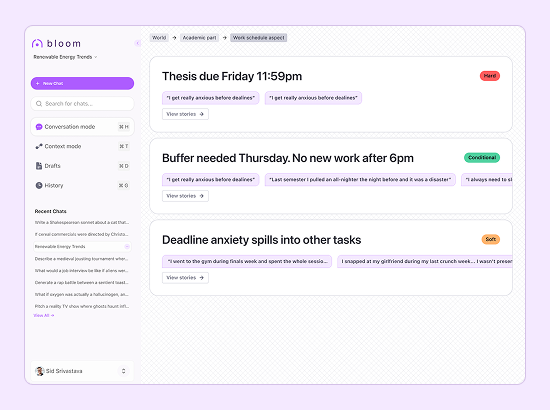
BLOOM externalizes the AI's working state. Instead of context buried in chat history where neither side can see it clearly, it becomes a visible, editable object that lives alongside the conversation. The chat handles dialogue. The context view handles the AI's model of you. They update each other, but stay structurally separate.
The context view is not a summary of the chat. It is a parallel representation of your world that the AI reads directly before generating every response. That makes BLOOM a soft explainability mechanism: it gives you enough visibility into the AI's working state to calibrate trust and intervene when it is wrong, without exposing model internals or demanding technical knowledge.
The identity container. It tells the AI that everything below belongs to one person with one coherent life, so it can reason across domains: a knee injury, a thesis deadline, and an $80 budget are constraints on the same human, sometimes in tension.
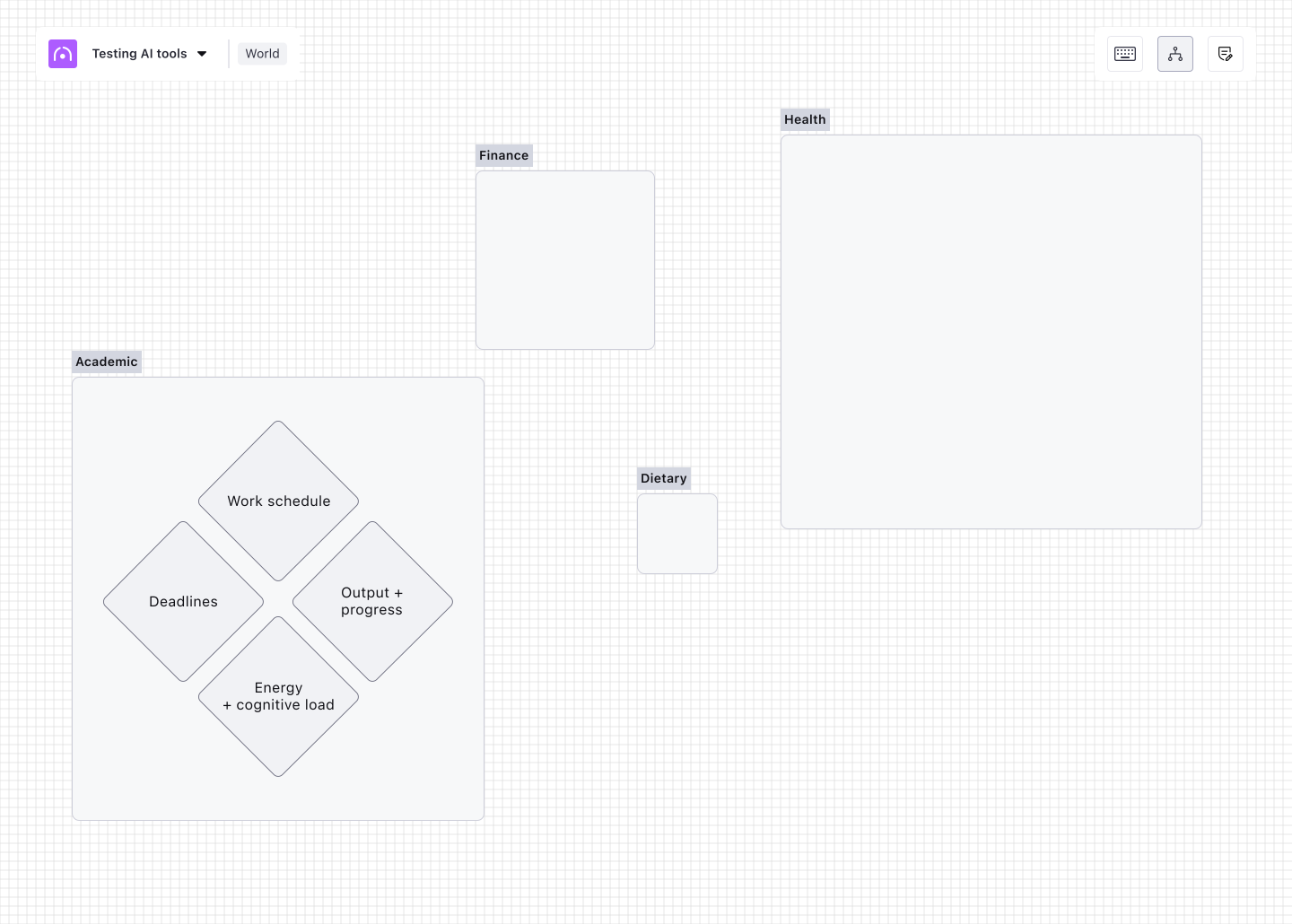
The major domains of a life. Academic, Health, Finance, Relationships, Creative work. Each Part is a bounded region of the World, and the AI treats constraints from different Parts differently.
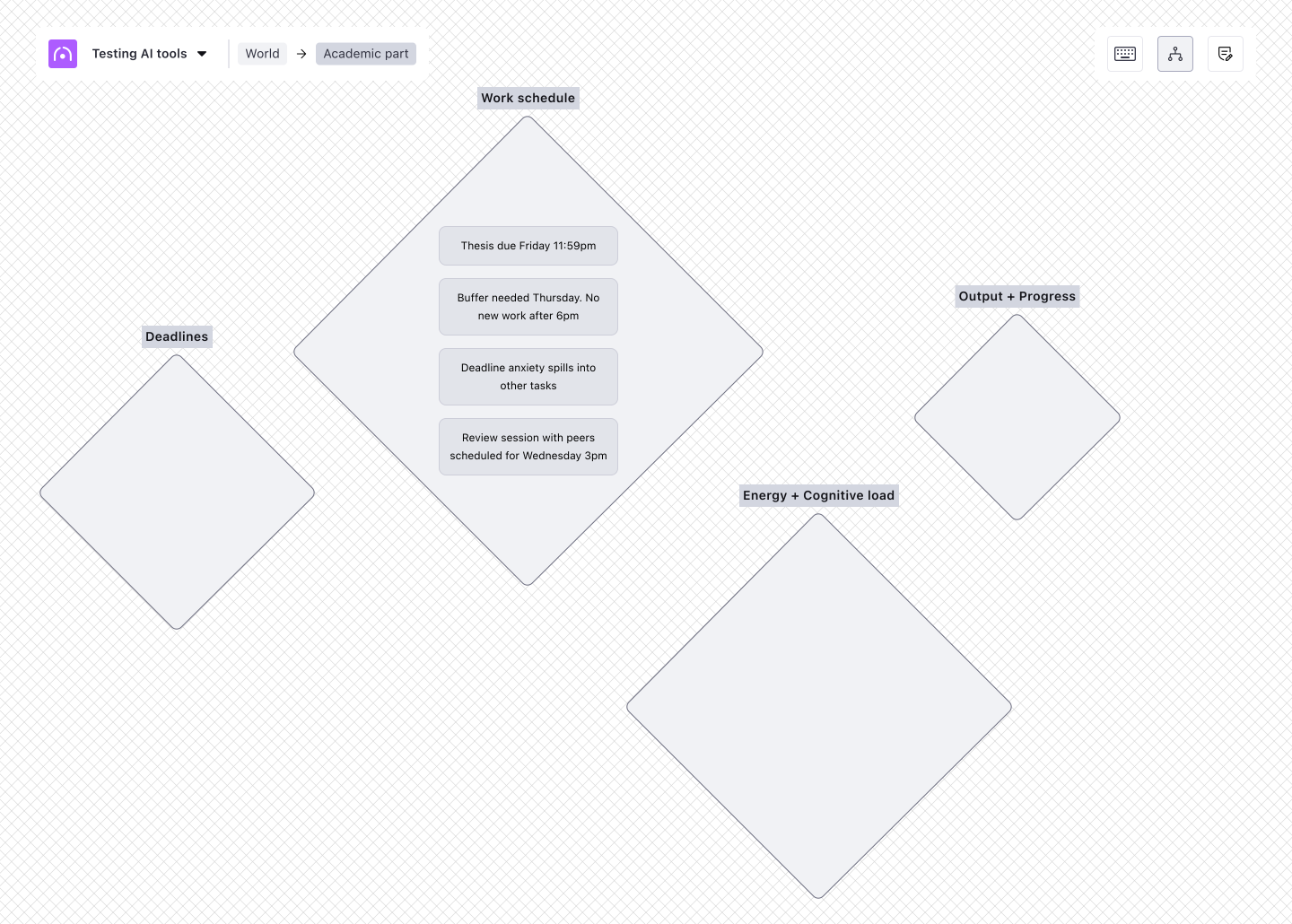
The dimensions within a Part. Within Academic: Deadlines, Work schedule, Output, Energy. Aspects are the interpretive frame, they tell the AI what kind of thing a Point is. The Aspect is what gives a Point its meaning.
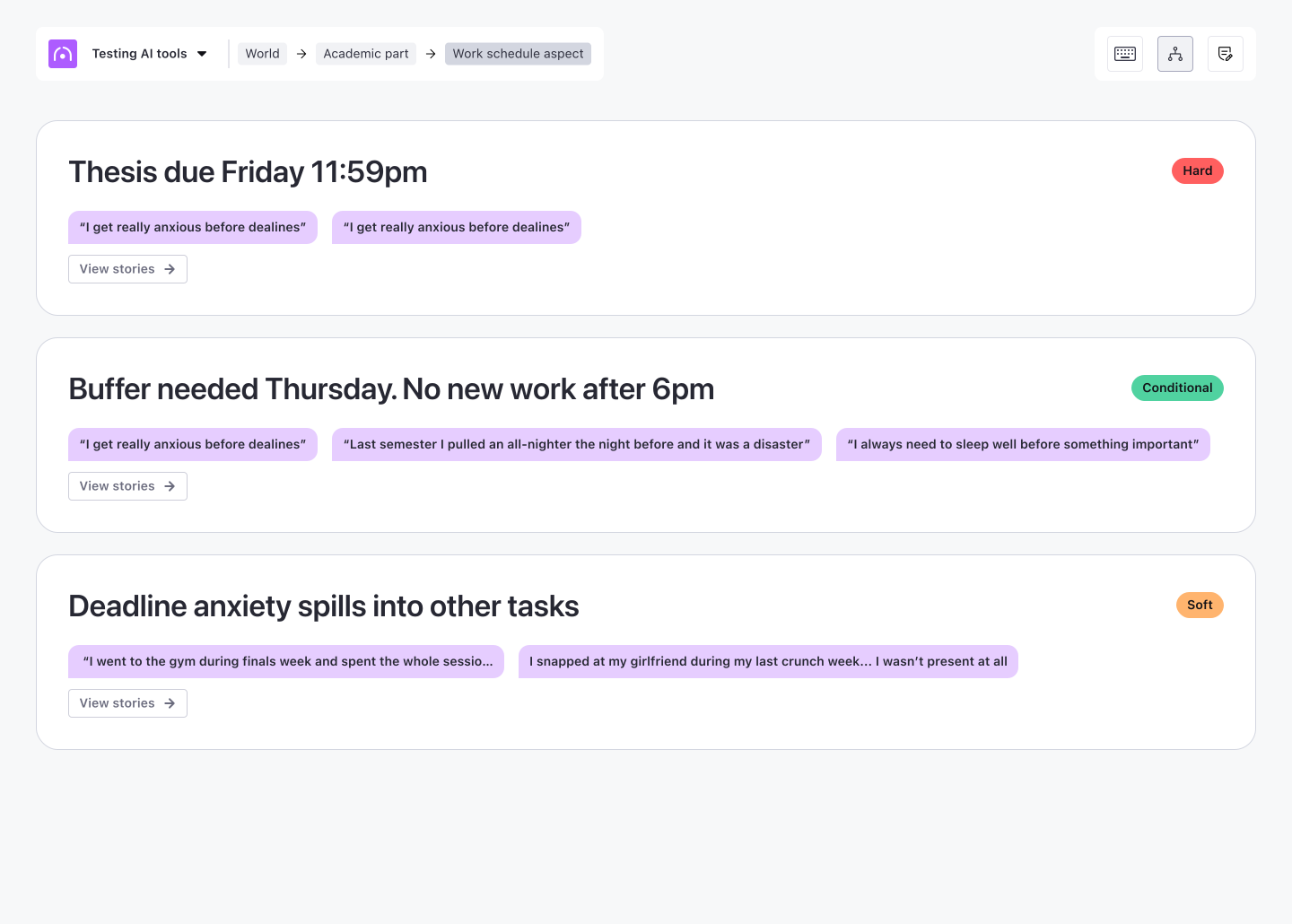
Machine-actionable facts. Concrete, specific, directly usable as constraints. "Thesis due Friday 11:59pm." "No shellfish, allergy." Everything below justifies a Point. Everything above contextualizes it.
The raw human evidence. Your own words, unprocessed and emotional. The AI does not act on Stories directly. It reads them to understand why a Point exists and how heavily to weight it. The relationship is many-to-many: one Story can ground four Points across three Parts.
This is Maya's world, our running example. Click a Part to zoom into its Aspects, click an Aspect to see its Points, then open a Point to read the Stories that ground it. Zooming is the only navigation. The act of going deeper is the act of moving down the hierarchy.
Live demoA faithful recreation of BLOOM's semantic-zoom canvas, built from the project's real sample data.
BLOOM tags every Point with one of three constraint types. They tell the AI how much flexibility it has, and they give it a decision hierarchy without asking users to assign numbers or understand model internals. Hard, conditional, and soft are vocabulary people already have.
The AI must never violate, suggest around, or treat these as negotiable. They carry irreversible or harmful consequences if ignored.
Respected only when a specific condition is active, and ignored when it is not. The condition is the trigger.
Genuine preferences the AI respects by default, but can trade off when something harder conflicts. Hard wins, then conditional, then soft.
BLOOM is built on Shneiderman's direct manipulation principles. The context view is not a form to fill out. It is a spatial, manipulable representation of your world, where spatial properties are semantic, not just aesthetic.
The zoom level corresponds exactly to the data layer. World shows Parts, zoom into a Part to reveal Aspects, into an Aspect to reveal Points, into a Point to reveal Stories. No tabs, no menus. You zoom.
When linking across Parts, dragging a connector beyond a boundary zooms out to the World, and into another Part zooms in. The drag gesture itself controls the level of abstraction. Intent surfaces the right view.
The hierarchy is a tree, but context is a graph. The same anxiety affects academics, gym focus, and budget. Aspects, Points, and Stories form explicit cross-Part edges that enable the AI to reason across domains.
A larger node carries more context weight in the AI's prompt. Nodes placed closer together are more semantically related. Moving two Parts closer is a direct intervention on the AI's semantic model.
World viewParts as bounded regions. Size reflects context weight, position reflects relatedness.
The research tests a specific hypothesis: that giving users direct manipulation over the AI's context layer improves constraint survival under change, reduces context drift, and increases trust calibration. Three conditions isolate the contribution of manipulation over mere visibility.
A standard conversational interface. Context is buried in history. No visibility, no manipulation. We expect the lowest constraint survival.
Context is externalized and visible alongside the chat. Users can see what the AI knows but cannot change it. Soft explainability without agency.
Context externalized, visible, and directly editable. Add, remove, edit, reposition, resize, and laterally link any node. Soft explainability with direct manipulation.
Does a constraint set early in the conversation survive a pivot task midway through? C1 should lose the most. C3 should hold. C2 isolates what visibility alone buys you, before you add the power to act.
The architecture is implemented as a working React application. The chat lives on the left, the context view on the right, and semantic zoom carries you from World, through Parts and Aspects, down to the Stories in your own words.
All Parts visible as bounded regions, sized by weight and arranged by relatedness.
Aspects appear as diamonds. Points sit within, each carrying its constraint type.
Points with their grounding Stories and constraint chips, ready to inspect and edit.

Chat and the editable context model side by side, each updating the other.
Language models manipulate linguistic form without grounding in intent. BLOOM does not fix that. It gives the model a structured, externalized cheat sheet that you control, one that cannot be lost mid-context, overwritten by earlier outputs, or degraded through failed correction.
You remain the authoritative source of your own context. The AI reads it. The interface makes the relationship between the two legible and steerable. That is the contribution: not a better model, but a directly manipulable, hierarchically structured, spatially organized context layer that sits between you and the machine.
It does not fetch past conversations across sessions. That is a different problem. BLOOM keeps context accurate, visible, and steerable within the session as it evolves.
Users do not write prompts. They manipulate context objects directly, and the AI reads those objects.
The context view is a parallel structure, maintained alongside the conversation and updated by it, but structurally independent.